

If you’ve spent any time in fountain pen circles, you’ve probably heard the name Rhodia mentioned with something close to reverence. Ask ten fountain pen enthusiasts which paper they trust most, and at least seven will say Rhodia. That kind of consistency does not happen by accident.
I came to Rhodia the way most of us do — frustrated. My first few weeks with a fountain pen were spent fighting paper that feathered, bled through, and turned my careful strokes into fuzzy marks. A fellow collector at my local pen club handed me a Rhodia pad and said, try it. One page was all it took.
What Makes Rhodia Paper Special?
Rhodia has been making paper in France since 1934. The brand was acquired by Clairefontaine in 1997, which is why both papers share certain qualities — but they are not identical. Rhodia has its own distinct character, and fountain pen writers have appreciated the difference for decades.
The core of Rhodia’s appeal is its surface treatment. The paper receives a special coating during manufacturing that creates an exceptionally smooth feel under the nib. Ink flows onto the page without hesitation, spreads cleanly, and dries without the fuzzy edges that ruin handwriting on lesser paper.
Paper Weights Explained
- 80 GSM (standard): The classic Rhodia weight, found in most pads and smaller notebooks. Excellent performance, very fountain pen-friendly.
- 90 GSM (Webnotebook R paper): A premium cream-colored paper found in bound notebooks. Slightly thicker, even more resistant to bleed-through, and gorgeous with shading inks.
- Acid-free and pH neutral: Your notes written today will be legible and unfaded decades from now.
Why Fountain Pen Users Keep Coming Back
Three words explain Rhodia’s popularity: no feathering, no bleed-through. These are the twin enemies of fountain pen writing on standard paper, and Rhodia eliminates both. The paper’s coating prevents ink from wicking sideways into the paper fibers, keeping every line crisp and intentional.
There is one small trade-off worth mentioning: because the surface is so smooth and resistant, ink takes slightly longer to dry on Rhodia than on more absorbent alternatives. If you are left-handed or tend to write quickly, give your ink a moment before sliding your hand across the page. A minor inconvenience for a major upgrade in writing quality.
Rhodia also handles ink shading beautifully. If you’ve invested in an ink with shading properties — darker at the start of a stroke, lighter at the end — Rhodia will show that effect clearly and consistently.
The Rhodia Product Range: What to Choose
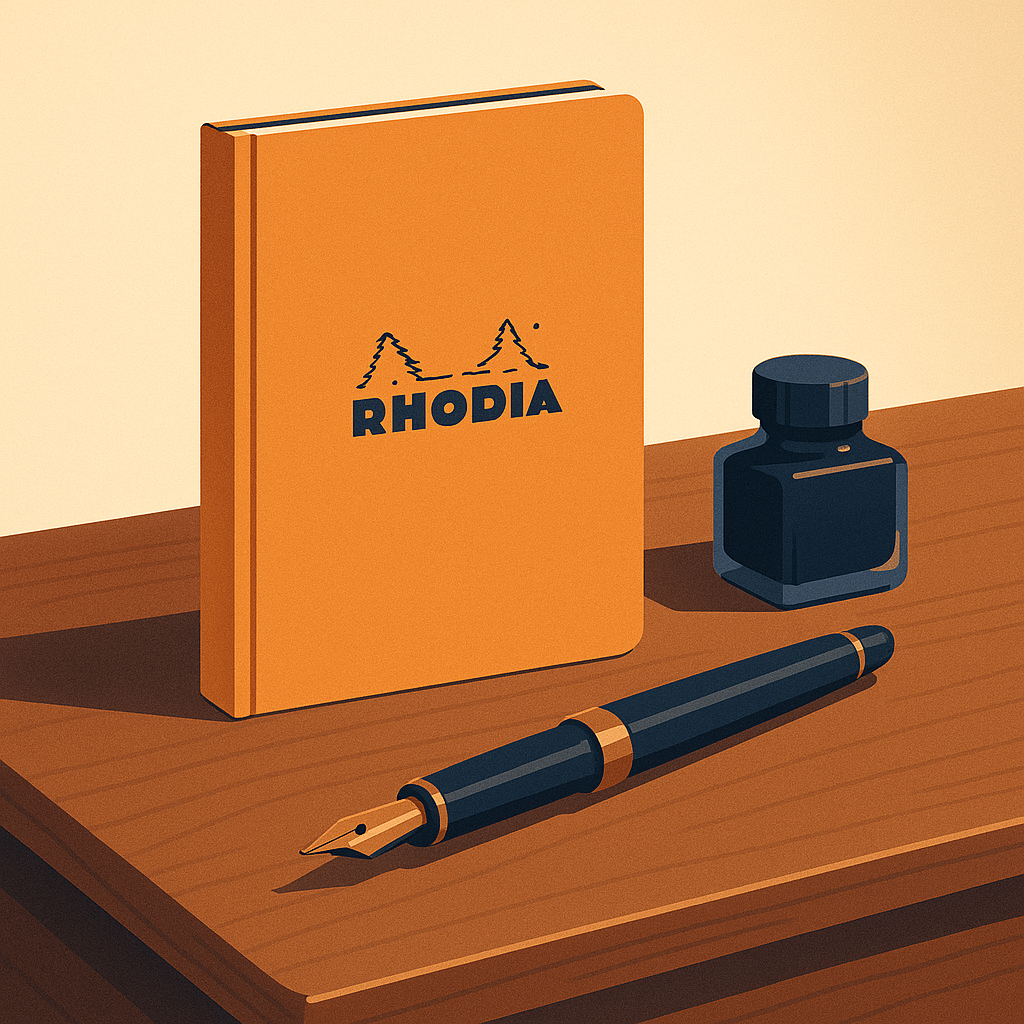

Rhodia makes more than one type of notebook, and knowing the differences will help you find the right one for your writing habits.
Rhodia Pads, Webnotebooks, and Goalbooks
Rhodia Pads (Bloc Rhodia): The original product. Spiral-bound or staple-bound, with a stiff cardboard back. Available in dotted, lined, blank, and graph options. These are the orange-covered pads you’ve likely seen — practical, affordable, and excellent for daily writing practice.
Rhodia Webnotebook: The premium option, with a soft leatherette cover and 90 GSM cream paper. This is Rhodia’s answer to the Moleskine — similar format, dramatically better paper. The elastic closure, bookmark ribbon, and back pocket make it functional as well as beautiful.
Rhodia Goalbook: A dot-grid notebook with pre-printed monthly and weekly spreads, designed for bullet journaling and planning. Same excellent paper, more structure for those who like their notebooks organized.
- For daily writing practice: A classic Bloc Rhodia pad in A5 — practical and inexpensive.
- For a dedicated journal: The Rhodia Webnotebook in A5 with 90 GSM cream paper.
- For planning and journaling together: The Rhodia Goalbook in A5 dot-grid.
Rhodia vs. Regular Notebook Paper
Zero feathering
Ink stays exactly where you put it, keeping lines crisp and handwriting clear.
Minimal bleed-through
Write on both sides of the page without worrying about ink showing through.
Beautiful ink shading
Shading and shimmer inks perform noticeably better on Rhodia’s smooth surface.
Acid-free longevity
pH-neutral paper means your writing will last for decades without yellowing.
Feathering and spreading
Fountain pen ink spreads unpredictably into paper fibers, blurring every stroke.
Bleed-through
Ink saturates through to the back, making both sides of the page unusable.
Muted ink colors
Absorbent paper wicks away ink depth, flattening shading and color richness.
Practical Tips for Getting the Most from Rhodia
- Let ink dry fully: Give it 5-10 extra seconds before moving your hand. The trade-off for smoothness is slightly longer dry time.
- Use a blotter if needed: Traditional writing desks often had blotter paper for exactly this reason — a useful accessory for wet writers.
- Try shading inks: Rhodia is one of the best papers to showcase shading properties of inks like Diamine Oxblood or Pilot Iroshizuku.
- Match your nib size: Even very wet nibs perform well on Rhodia, but fine nibs in particular benefit from the zero-feathering surface.
Frequently Asked Questions
Is Rhodia paper the same as Clairefontaine?
They are related but not identical. Both are made by the same parent company in France, and they share similar qualities. Rhodia paper tends to be slightly cooler white and somewhat smoother; Clairefontaine is often perceived as slightly more consistent across products. Both are excellent for fountain pens.
Which Rhodia notebook is best for beginners?
Start with a Bloc Rhodia A5 pad in dotted or lined format. It’s affordable, shows off Rhodia’s paper quality immediately, and the format works equally well for journaling, letter practice, or casual note-taking. Once you are confident Rhodia is the right fit, upgrade to the Webnotebook for a more polished experience.
Does Rhodia work with all fountain pen inks?
In our experience, yes — with very rare exceptions. Virtually all standard fountain pen inks from Pilot, Diamine, Iroshizuku, Sailor, and Waterman perform beautifully on Rhodia. Some extremely wet inks may show slightly longer dry times, but feathering and bleed-through remain minimal.
Where can I buy Rhodia notebooks in the United States?
Rhodia is widely available through specialty pen retailers like Goulet Pens, JetPens, and Anderson Pens. You will also find them at many art supply stores, some bookshops, and online through major retailers.
Final Thoughts
Rhodia notebooks have earned their reputation honestly, one feather-free page at a time. When you invest in a quality fountain pen and a bottle of beautiful ink, you deserve paper that lets both perform at their best. Rhodia delivers that — consistently, reliably, and with a certain French elegance that feels entirely appropriate for the fountain pen hobby.
If you have not tried writing on Rhodia paper yet, pick up a simple Bloc Rhodia pad this week. The difference from regular paper will be immediately apparent. And once you’ve felt that smooth, confident flow of ink across a properly treated surface, it is hard to go back.