

Think back to the last time you opened your mailbox and found a real letter, handwritten, personally addressed, sealed with care. There is a moment of stillness that comes before you even open it, a recognition that someone took time, pressed pen to paper, and thought of you. That feeling is almost impossible to replicate in a text message or an email, no matter how warmly worded.
Handwritten correspondence is not truly lost, it is simply waiting for us to remember how good it feels. And there is no better tool to revive it with than a fountain pen.
What Makes a Handwritten Letter Different?
A handwritten letter is a physical artifact of someone’s attention. Every loop, every crossing of a letter, every small imperfection in the ink carries the unmistakable trace of a real human hand. It cannot be mass-produced, forwarded with a click, or sent to fifty people at once. It exists in only one place, for only one person.
The Digital Gap That Letters Fill
We receive hundreds of digital messages each week and remember very few of them. Handwritten letters are different. Research from cognitive scientists at Princeton and UCLA suggests that information processed through handwriting is encoded more deeply and retained longer than the same information processed through typing. A letter received is often a letter kept.
Why the Fountain Pen Matters Here
You can write a letter with any pen. But a fountain pen changes the experience in ways that matter. The smooth, effortless flow of ink means your hand does not tire the way it does with a ballpoint. The wide range of ink colors gives you a subtle but real way to express personality, writing in a warm sepia or a soft teal says something before the words even begin.
Why This Tradition Deserves to Come Back
In a world of instant communication, slowness has become a form of generosity. Writing a letter by hand says: I gave you my time. I thought carefully about what to say. I chose words that cannot be unsent. That investment of care is something the recipient feels before they finish reading the first line.
How to Write Your First Letter, or Your First in Years
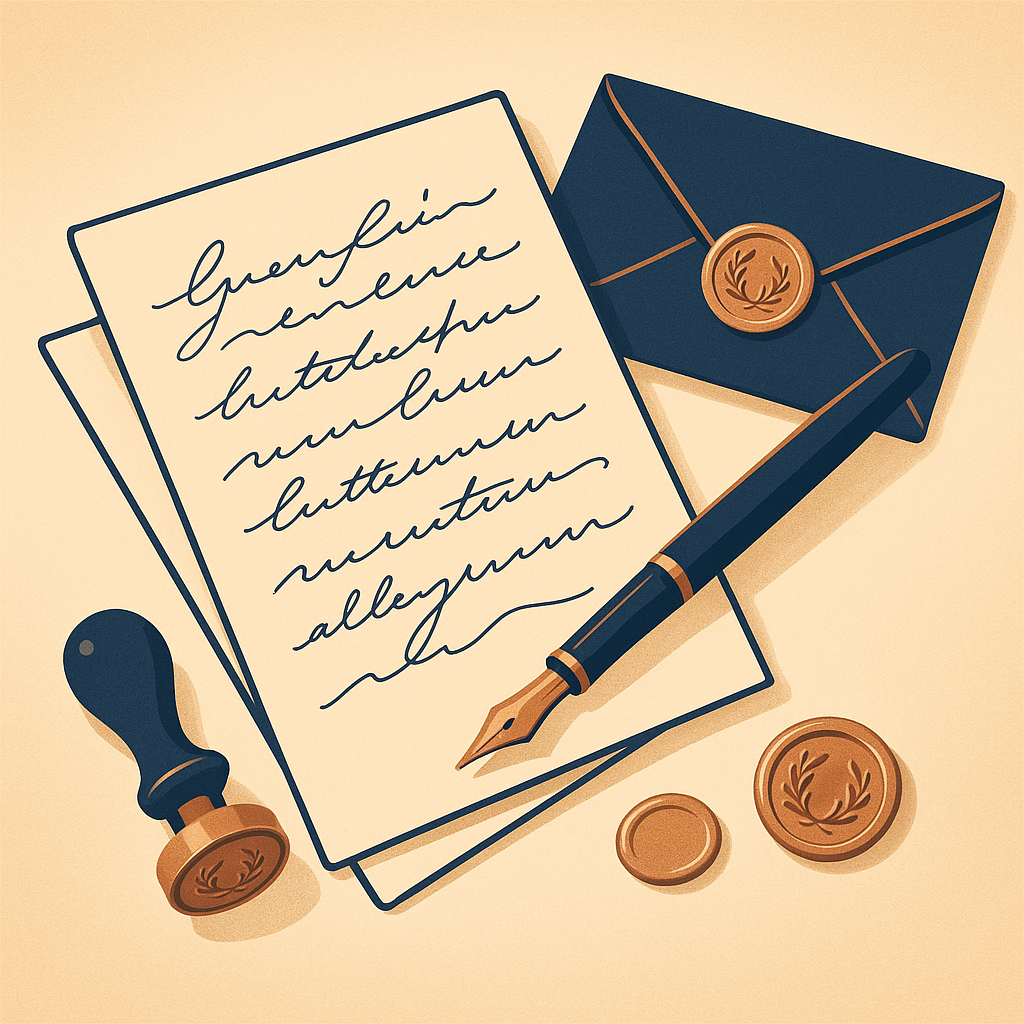
The most common obstacle to letter writing is not knowing how to begin. Here is a simple approach that removes all the pressure:
- Choose one person: Do not try to write to everyone at once. Pick someone you have been thinking of, a childhood friend, a sibling, a former colleague you admire.
- Start with what is true: Begin with something simple, such as: I was thinking about you the other day when… This grounds the letter in real feeling rather than performance.
- Write as you speak: Formal language is not required. Write the way you would talk to this person over coffee. The warmth in your voice translates beautifully to ink.
- Keep it to one or two pages: Brevity shows respect for the reader’s time. A focused, heartfelt single page is worth far more than a rambling three-page letter.
- Sign your full name: There is something satisfying and personal about a written signature that differs from every typed name ever sent.
Choosing Paper and Envelope That Match the Moment
The letter is not just the words. It is the whole physical experience: the weight of the paper in the hand, the texture under the fingers, the way the ink sits on the surface. For fountain pens, smooth paper is essential. Rhodia, Clairefontaine, or a quality writing pad from a local stationery shop will all work beautifully. Avoid thin, absorbent paper, as ink will feather and lose its crisp edge.
Pros and Cons of Reviving Handwritten Correspondence
Creates Lasting, Meaningful Connections
Handwritten letters are kept, reread, and treasured in ways that digital messages simply are not.
A Genuinely Rare and Memorable Gift
In an age of constant digital noise, a personal letter stands out as something thoughtful and uncommon.
Encourages Slow, Reflective Thinking
Composing a letter by hand forces you to choose words carefully, which deepens your own thinking as much as the recipient’s experience.
Takes More Time Than an Email
A thoughtful handwritten letter requires thirty minutes or more. For frequent communication, this is not always practical.
No Instant Delivery or Confirmation
Postal letters take days to arrive. If the message is time-sensitive, digital communication remains the better choice.
Frequently Asked Questions
Do I need beautiful handwriting to write letters?
Not at all. Handwriting that is legible and clearly your own is far more personal than polished calligraphy. The recipient is not grading your penmanship, they are reading your words and feeling your care.
What ink color works best for letters?
Classic blue or black inks are easy to read and photographically archivable. For more personal or artistic letters, sepia, forest green, or soft burgundy inks add warmth and character without sacrificing legibility.
Is it strange to send a letter to someone who mostly uses email?
It is unexpected, and that is exactly the point. Most people who receive a handwritten letter are genuinely moved by it, even if they had not thought to write one themselves. You may find your letter prompts a reply in kind.
How do I keep my fountain pen from smearing on the paper?
Allow the ink to dry for at least thirty seconds before folding or inserting the letter. Some inks, especially wet or shimmery ones, take longer. A light blotter pressed gently on the page after writing is a reliable solution.
Final Thoughts
Reviving letter writing does not require a dramatic commitment. It begins with one letter, to one person who matters to you, written on a quiet afternoon with your favorite fountain pen and the ink color that feels right today. That is the entire starting point.
The tradition does not need saving through grand gestures. It simply needs the two of you: a writer who cared enough to reach for a pen, and a reader who will hold something real in their hands.