

If your handwriting has become a source of mild embarrassment — or simply something you’ve neglected over years of keyboards and touchscreens — a fountain pen might be the most enjoyable solution you’ve never considered.
Unlike ballpoints, which require pressure to deposit ink, fountain pens flow freely with almost no force at all. That fundamental difference changes how you hold the pen, how your hand moves across the page, and ultimately, how your letters look. Many writers find that their handwriting improves naturally within weeks of switching to a fountain pen — not through drilling, but simply through enjoyable, regular use.
Why Fountain Pens Improve Handwriting
There are a few mechanical reasons why fountain pens tend to produce better handwriting. First, they reward a light touch. When you grip a ballpoint tightly and press hard, your hand tenses up — and tight muscles produce shaky, inconsistent lines. A fountain pen punishes a heavy grip by skipping or scratching, which quickly teaches you to relax.
Second, fountain pens encourage arm writing rather than finger writing. Because the nib is sensitive and requires a consistent angle, experienced users naturally shift to using their forearm and shoulder for movement, which produces smoother, more controlled strokes. This is the same technique taught in traditional penmanship instruction.
Getting Your Grip and Posture Right
Before practicing letter shapes, it’s worth addressing the basics of how you hold and position yourself at the desk. These fundamentals do more for handwriting than any amount of letter drilling.
The Relaxed Tripod Grip
Hold the pen between your thumb and index finger, resting it on the side of your middle finger. Your grip should feel secure but not tight — if your knuckles are white, you’re holding too hard. The pen should feel like it could almost fall if you relaxed your fingers just a little more. That’s the sweet spot.
Pen Angle and Paper Position
Keep the nib at roughly 45–55 degrees to the paper. Tilt your paper slightly — right-handers typically angle it counterclockwise; left-handers clockwise. Adjusting the paper angle, rather than twisting the pen, is always the right move when something feels uncomfortable.
Sitting Posture
Sit upright with both feet flat on the floor. Rest your forearm on the desk rather than bending your wrist upward. Your elbow should be near the edge of the table. This position lets your whole arm move freely rather than pivoting at a cramped wrist.
Practical Exercises to Improve Your Letterforms
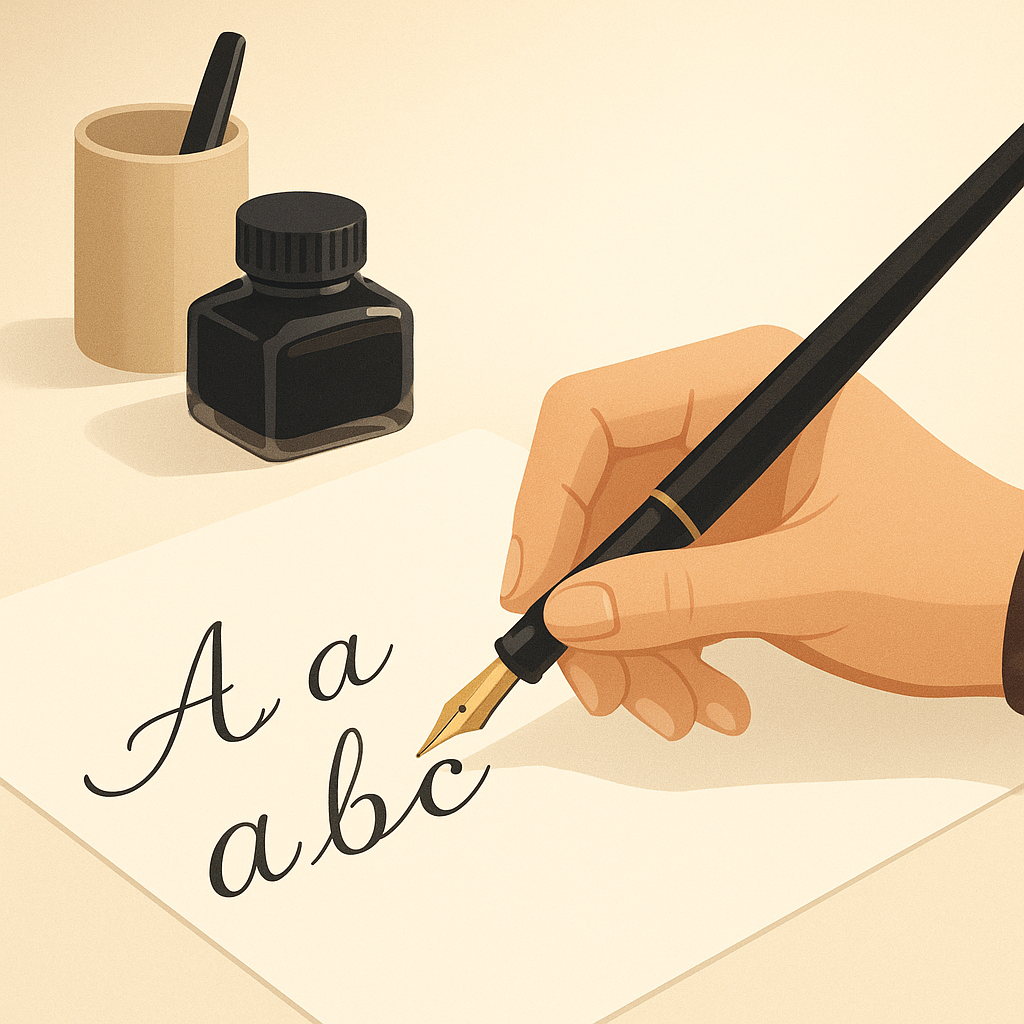
Once your grip and posture are comfortable, targeted practice accelerates improvement considerably. These exercises are simple, effective, and can be done in just 10 minutes a day.
- Oval drills: Draw continuous, connected ovals across the page. This builds the smooth circular motion that forms the basis of most letters — especially lowercase a, d, g, q, and o.
- Up-down strokes: Draw evenly spaced vertical strokes, keeping them parallel and consistent in height. This trains arm movement and rhythm.
- Letter families: Practice letters in groups that share strokes — n, m, u, v, w share a similar humped motion; i, l, t, d share vertical strokes. Working on families builds muscle memory faster than random practice.
- Slow, deliberate sentences: Copy a sentence you find beautiful — from a book, a poem, or simply something meaningful. Write it slowly, focusing on individual letterforms rather than speed.
- Daily journaling: Regular, purposeful writing in a journal is the single most effective long-term exercise. Five minutes of intentional writing daily will produce visible improvement within a month.
Common Handwriting Problems and How to Fix Them
Most handwriting issues have specific, addressable causes. Here are the most common ones and their straightforward solutions.
Inconsistent Letter Size
Usually caused by finger writing rather than arm writing. Try using lined or grid paper for a few weeks to train your eye. Rhodia dot pads are excellent for this — the subtle dots provide guidance without being distracting.
Uneven Slant
Varying slant is often a paper position problem. Experiment with tilting your paper at a more pronounced angle. Many writers find that a consistent slant appears almost automatically once the paper is positioned correctly.
Shaky or Wobbly Lines
Almost always a grip tension problem. If your lines look shaky, deliberately loosen your grip. Rest your arm more firmly on the desk and try writing larger than usual — bigger movements are easier to control and will feel smoother.
Pros and Cons of Using a Fountain Pen to Improve Handwriting
Naturally Encourages Better Technique
The design of a fountain pen promotes lighter grip and arm-led movement, improving handwriting without deliberate effort.
Reduces Hand Fatigue
The effortless ink flow means less pressure, which makes extended writing sessions more comfortable and sustainable.
Immediate Visual Feedback
You can see the effect of grip changes and angle adjustments instantly in your line quality, making it easier to self-correct.
Improvement Takes Consistent Practice
Results aren’t instant. Daily writing over several weeks is needed before noticeable improvement appears in your everyday handwriting.
Left-Handed Writers Face Extra Challenges
Left-handers need to adjust paper angle and grip carefully to avoid smearing wet ink across the page, which requires a short adaptation period.
Frequently Asked Questions
How long does it take to see improvement in handwriting?
Most people notice meaningful improvement within two to four weeks of daily practice. Consistency matters far more than session length — 10 minutes every day outperforms an hour once a week.
Should I practice cursive or print with a fountain pen?
Either works, and both benefit from fountain pen use. Cursive tends to improve more dramatically because the connected strokes naturally encourage the flowing arm movement that fountain pens reward. But if you prefer print, you’ll still see results.
Does nib size affect how my handwriting looks?
Yes. A fine nib gives you more precise, delicate lines — great for small handwriting. A medium nib is more forgiving and produces expressive lines that many people find more satisfying. Stub or italic nibs add natural variation that can make ordinary handwriting look almost calligraphic.
Can older adults really improve their handwriting?
Absolutely. The brain’s ability to build new motor habits doesn’t disappear with age — it just requires patience and consistency. Many of the most dedicated fountain pen handwriting practitioners are retirees who have the time and motivation to develop a beautiful, deliberate hand.
Final Thoughts
Improving your handwriting with a fountain pen is less about discipline and more about developing a habit you genuinely enjoy. When writing feels good — when the pen glides smoothly and the ink flows richly across good paper — you naturally want to practice more. And that enjoyment is what produces lasting improvement.
Start with a good pen, pay attention to your grip and posture, and write a little every day. Your handwriting will thank you within a month.