If you've recently discovered the joy of fountain pen writing, you've likely encountered your first big decision: cartridges or bottled ink? It's a question that sparks passionate debates among fountain pen enthusiasts, and for good reason. Each option offers distinct advantages that can significantly impact your writing experience.
Like choosing between convenience store coffee and grinding your own beans, the cartridge versus bottled ink debate comes down to personal priorities. Do you value simplicity and cleanliness, or do you prefer variety and cost savings? Let's explore both paths to help you make the right choice for your writing journey.
Whether you're filling your fountain pen for the first time or reconsidering your current approach, understanding these differences will enhance both your writing experience and your enjoyment of this timeless hobby.
What Are Ink Cartridges?
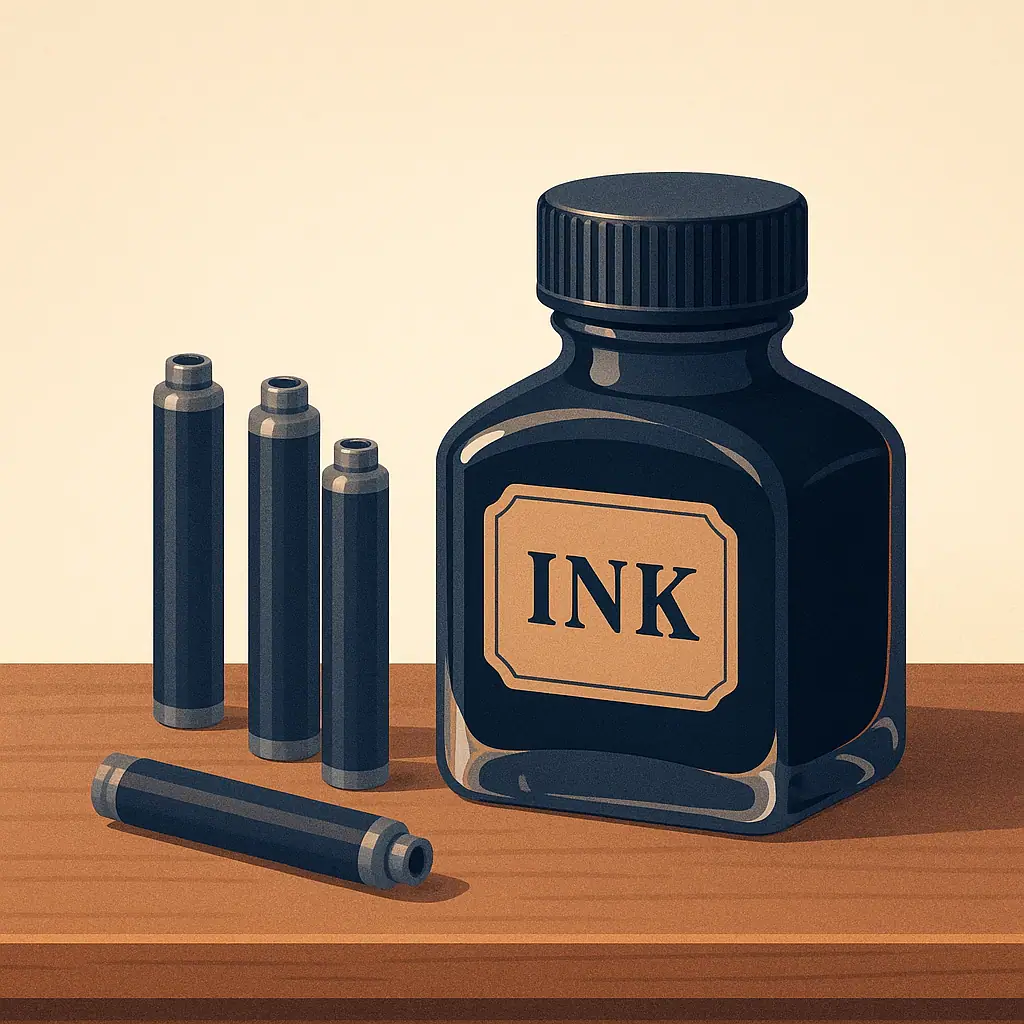
Ink cartridges are small, sealed plastic containers pre-filled with fountain pen ink. They're designed to fit directly into your pen's grip section, providing instant access to fresh ink without any mixing, measuring, or mess.
Think of cartridges as the "instant coffee" of the fountain pen world — convenient, consistent, and ready to use. Most fountain pen manufacturers produce cartridges in their standard colors: black, blue, blue-black, and sometimes red or green. The beauty lies in their simplicity: remove the old cartridge, insert the new one, and you're writing within seconds.
Key Cartridge Specifications
- Compatibility: Most cartridges follow international or proprietary standards
- Capacity: Typically hold 0.7-1.4ml of ink
- Lifespan: Generally last 1-3 weeks depending on writing frequency
Understanding Bottled Ink Systems
Bottled ink requires either a converter (a reusable cartridge-like device with a filling mechanism) or a built-in filling system within your pen. This approach opens up a vast world of ink colors, properties, and brands that simply aren't available in cartridge form.
Using bottled ink is like having access to a paint shop instead of a basic palette. Premium ink makers like Diamine offer over 80 colors, while artisan brands create unique formulations with shimmer, sheen, and special properties that transform ordinary writing into something magical.
Cost Comparison: Your Wallet Will Thank You
Here's where bottled ink shines brightest. While the initial investment in a converter and ink bottle might seem higher, the long-term savings are substantial.

Breaking Down the Numbers
💰 Cartridge Costs:
Premium cartridges cost $0.75-$1.50 each and contain roughly 1ml of ink. That translates to approximately $25-50 per ounce of ink.
💡 Bottled Ink Economics:
A 30ml bottle of quality ink costs $8-15 and refills your converter 20-30 times. This brings your cost down to $8-15 per ounce — a savings of 60-80%.
For regular writers, switching to bottled ink can save $100-200 annually while providing access to far more interesting colors and properties.
Convenience Factor: When Easy Wins
Cartridges excel in situations where convenience trumps variety. Business meetings, travel, and quick writing sessions all favor the plug-and-play simplicity of cartridges.
Travel-Friendly Advantages
🎯 Travel-Friendly Features:
- No Spills: Sealed cartridges won't leak in your luggage
- Airport Security: Small cartridges rarely trigger liquid restrictions
- Quick Swaps: Change colors instantly without cleaning
- No Equipment: No converters or syringes to pack
Many professionals keep cartridges as backup even when they primarily use bottled ink. There's wisdom in having both options available for different situations.
Color Variety and Special Properties
This is where bottled ink becomes irresistible. While cartridge manufacturers typically offer 4-8 standard colors, bottled ink opens up thousands of possibilities.
🌈 Exclusive Bottled Ink Features:
- Shimmer Inks: Metallic particles create sparkle effects
- Sheening Inks: Colors that shift and reflect light
- Iron Gall: Historic formulations with permanent properties
- Seasonal Collections: Limited editions and artist collaborations
- Custom Mixing: Create your own unique colors
For writers who view their fountain pen as a creative tool rather than just a writing instrument, bottled ink transforms each page into a canvas of possibilities.
Pros and Cons
Ultimate Convenience
Insert and write immediately, no preparation needed.
Clean and Mess-Free
No ink bottles, syringes, or potential spills to worry about.
Perfect for Travel
TSA-friendly and leak-proof in luggage.
Higher Long-term Cost
3-5x more expensive per ml than bottled ink.
Limited Color Options
Typically only 4-8 standard colors available.
Environmental Impact
Single-use plastic creates more waste than bottles.
Exceptional Value
60-80% cheaper per ml with better quality options.
Unlimited Color Choices
Thousands of colors, sheens, and special properties.
Eco-Friendly
One bottle replaces 20-30 plastic cartridges.
Requires Equipment
Need a converter or built-in filling system.
Messier Process
Filling can be tricky and occasionally messy.
Travel Complications
Bottles can leak and may face airport restrictions.
Making Your Choice: A Practical Guide
The best choice depends on your writing habits, priorities, and experience level. Many fountain pen users find that their preference evolves over time, starting with cartridges for simplicity and gradually embracing bottled ink for variety and value.
Decision Framework
Choose cartridges if you:
- Are new to fountain pens and want simplicity
- Travel frequently for work
- Primarily use standard colors (black, blue, blue-black)
- Value convenience over cost savings
- Have limited desk space or time for maintenance
Choose bottled ink if you:
- Write regularly and want to save money long-term
- Enjoy exploring different colors and properties
- View fountain pen writing as a hobby, not just a tool
- Want environmentally conscious options
- Don't mind spending extra time on pen maintenance
Frequently Asked Questions
Can I refill empty cartridges with bottled ink?
Yes! This hybrid approach combines cartridge convenience with bottled ink variety. Use a blunt syringe to refill cleaned cartridges, giving you the best of both worlds.
Do all fountain pens accept both cartridges and converters?
No. Some pens only accept cartridges, others only use built-in filling systems, and some work with both. Check your pen's specifications before purchasing ink supplies.
How long does bottled ink last compared to cartridges?
Both cartridge and converter fills typically last 1-3 weeks with regular writing. However, bottled ink stays fresh for years when stored properly, while cartridges can dry out over time.
Which is better for fountain pen beginners?
Cartridges are ideal for absolute beginners due to their simplicity. Once comfortable with basic fountain pen operation, trying bottled ink opens up new possibilities and long-term savings.
Final Thoughts
The cartridge versus bottled ink debate isn't about finding a single "correct" answer — it's about matching your ink choice to your lifestyle and writing goals. Many experienced users keep both options on hand, using cartridges for travel and convenience, while enjoying bottled ink for daily writing and color exploration.
Remember that your fountain pen journey is personal. Start with what feels comfortable, whether that's the simplicity of cartridges or the adventure of bottled ink. As your confidence grows, you can always explore the other option. The beauty of fountain pens lies not in rigid rules, but in discovering what brings you the most joy in your writing experience.
Whatever you choose, you're participating in a tradition that spans centuries, connecting your modern writing to the rich history of fountain pen craftsmanship. That connection remains magical, whether your ink comes from a small plastic cartridge or a beautiful glass bottle.