
There is a moment that fountain pen writers often describe as a revelation — the first time they write on paper that was truly made for their pen. For many, that moment happens with Clairefontaine. The French company has been producing paper since 1858, and their notebooks have quietly become the benchmark against which fountain pen users measure every other writing surface.
My own introduction came through a simple ruled notebook in a cream cover. I had been struggling with ink that feathered on every notebook I tried, turning careful cursive into something that looked like it was written in a hurry on cheap paper. Clairefontaine changed that instantly, and I have not looked back since.
What Is Clairefontaine Paper?
Clairefontaine is a French paper manufacturer based in the Vosges region, producing paper in the same location since the 19th century. Their paper is recognized by fountain pen enthusiasts worldwide as a benchmark of quality — specifically because of its unique surface coating that prevents the two most common complaints in fountain pen writing: feathering and bleed-through.
The Science Behind the Smoothness
What makes Clairefontaine paper distinctive is a special ink-resistant coating applied during manufacturing. This coating creates a silky-smooth surface that allows ink to glide across the page without friction, and more importantly, prevents the ink from spreading laterally into the paper fibers. The result is crisp, clean lines that honor every variation in your nib’s pressure and movement.
- 90 GSM standard weight: Clairefontaine’s notebooks typically use 90 GSM paper, which is heavier than many competitors and significantly reduces show-through.
- Bright white surface: The paper’s white tone makes ink colors pop and shading effects more visible than on cream or ivory paper.
- Consistent quality: Unlike some brands where quality varies by batch, Clairefontaine is known for remarkable consistency across years of production.
Why Clairefontaine Is Considered the Benchmark
When fountain pen enthusiasts discuss paper, Clairefontaine is often the standard everything else is measured against. This reputation comes from decades of consistent performance across a wide range of nibs, inks, and writing styles.
The paper’s bright white surface deserves special mention. Unlike cream papers, which absorb some of the ink’s depth, Clairefontaine’s white tone makes every ink color appear at its most vivid. Blues look bluer, greens look richer, and the shading in well-behaved inks — where the color darkens at the beginning of a stroke and lightens as the pen moves — becomes clearly visible and beautiful.
One area where Clairefontaine differs from competitors like Rhodia is dry time. Because the surface is so resistant to ink absorption, your writing will take a few extra seconds to dry completely. For right-handed writers, this is usually not noticeable. Left-handed writers who write at a steep angle across fresh marks should allow a few extra moments, or choose a quicker-drying ink for everyday use.
The Clairefontaine Notebook Range
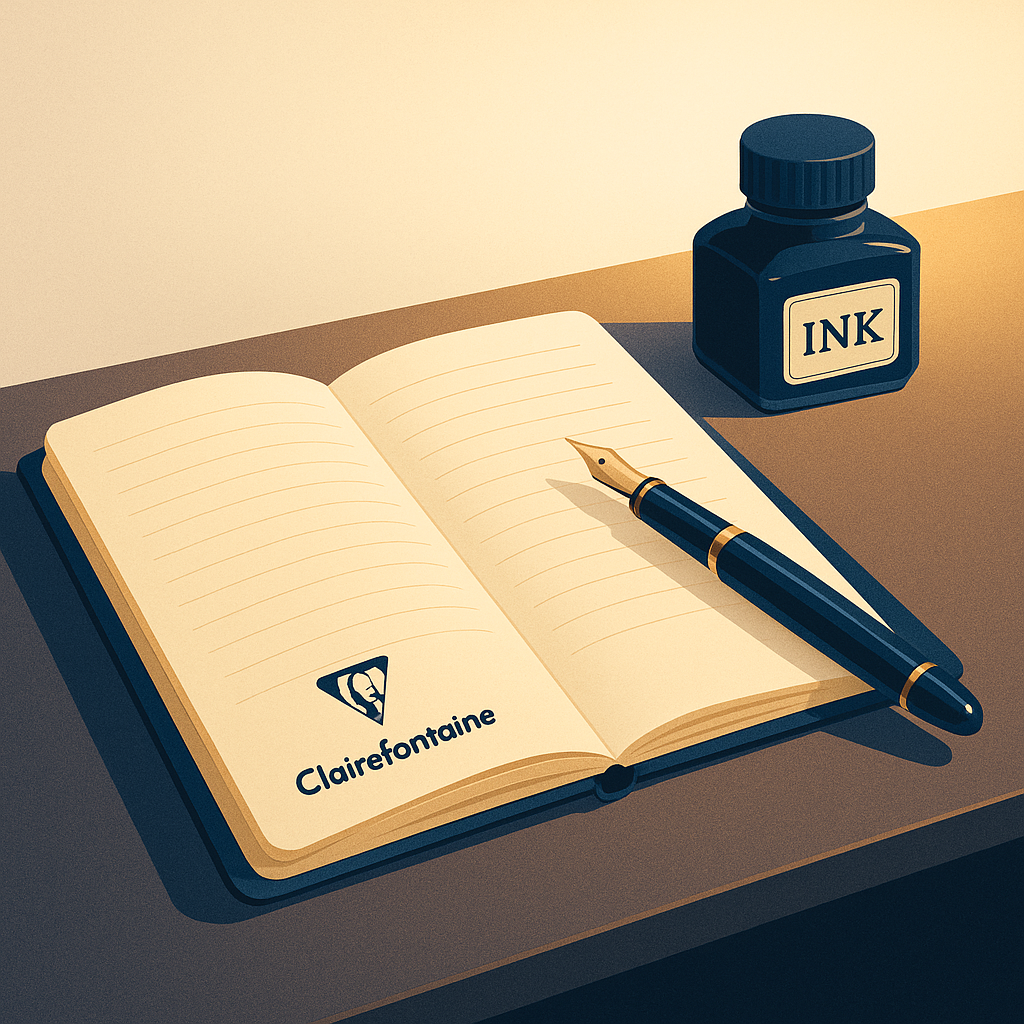

Clairefontaine produces a wide range of notebooks and writing papers, from simple school pads to elegant bound books designed for serious writers. Here is what you are likely to encounter as a fountain pen user.
Key Clairefontaine Products for Pen Writers
Classic Ruled Notebooks: The most recognizable Clairefontaine product — thin ruled lines on white 90 GSM paper. These come in A4 and A5 sizes, with soft covers in a range of colors. They are the most economical way to experience Clairefontaine’s paper quality.
Triomphe Writing Paper: Clairefontaine’s flagship writing stationery. Larger sheets, unlined, designed for correspondence. If you write letters with a fountain pen, Triomphe is one of the finest papers you can use.
Clairefontaine 1951 Notebooks: A modern design with a vintage-inspired aesthetic. Hardcover, sewn binding, available in lined and dot-grid formats. The paper is the same excellent 90 GSM stock.
- For everyday journaling: A classic A5 soft-cover ruled notebook — affordable and excellent.
- For correspondence: Triomphe writing paper, which makes letters feel like the special occasion they are.
- For a premium experience: The 1951 hardcover notebooks, which pair beautiful design with reliable paper.
Clairefontaine vs. Other Premium Papers
Zero feathering on virtually all inks
The specialized surface coating keeps every line crisp and clean regardless of ink type.
Exceptional ink color vibrancy
The bright white surface makes ink colors appear more vivid than on cream papers.
Consistent quality batch to batch
Unlike some brands with variable quality, Clairefontaine delivers reliably excellent paper every time.
Wide product variety
From simple school pads to correspondence paper, Clairefontaine covers every writing need.
Longer dry time
The smooth coating slows ink absorption, requiring a few extra seconds before moving your hand.
Less sheen on some inks
The bright white surface reduces the metallic sheen effect on sheen-heavy inks compared to coarser papers.
Not as widely available as generic notebooks
Finding Clairefontaine may require a specialty pen shop or online order if you live in a smaller city.
Tips for Writing on Clairefontaine Paper
- Be patient with dry time: Allow 5-15 seconds depending on your ink’s wetness before touching the page. Keep a piece of scrap paper under your writing hand if needed.
- Try your most saturated inks: Clairefontaine rewards you with vibrant colors that lesser paper would muddy or absorb unevenly.
- Use fine nibs with confidence: The zero-feathering surface makes hairline strokes possible even with very wet inks.
- Explore writing papers: If you write letters, Triomphe writing paper is an experience that changes how you think about correspondence.
Frequently Asked Questions
Is Clairefontaine better than Rhodia?
They are made by the same parent company, and both are excellent. The differences are subtle: Clairefontaine tends to have a brighter white tone and slightly more consistent quality across products; Rhodia comes in a wider range of notebook formats and is slightly more widely available. Most fountain pen writers enjoy both and choose based on personal preference and format.
Will ink take too long to dry on Clairefontaine?
For most writers, the dry time is slightly longer than on absorbent paper but not problematic. Right-handed writers rarely notice. Left-handed writers or those who write very quickly may want to choose a faster-drying ink — most iron gall inks and many standard blue-black inks dry quickly on Clairefontaine without issue.
Where can I buy Clairefontaine notebooks in the US?
Specialty pen retailers like Goulet Pens, JetPens, and Pen Chalet carry Clairefontaine products. Many art supply stores stock at least some Clairefontaine products, and they are readily available online through major retailers. The classic ruled notebooks are typically very affordable for the quality you receive.
Does Clairefontaine work well with broad and stub nibs?
Exceptionally well. Broad and stub nibs deposit more ink per stroke, which is exactly where Clairefontaine’s resistance to feathering and bleed-through makes the most noticeable difference. The wider lines stay crisp, and any shading in your ink becomes prominently visible across the broader strokes.
Final Thoughts
Clairefontaine has earned its benchmark status through consistency, quality, and a genuine understanding of what writers need from their paper. It is not flashy or dramatically different in appearance from other notebook brands, but the moment your fountain pen touches that smooth, coating-treated surface, the difference is unmistakable.
For fountain pen writers who want the most reliable, versatile, and consistently excellent paper available, Clairefontaine is one of the finest choices at any price point. Start with a simple ruled notebook, fill it with an ink you love, and discover what fountain pen writing is truly capable of.